One of the themes that runs through my work, professional and scholarly, is how our encounters with information can deepen our experience of time.
The Long Now Foundation has always been a source of inspiration for me, and a few months ago I submitted a concept for their Book of Time project. My proposal was not accepted, so I’ll share it here.
Augustine described our experience of time as a simultaneous presence of the past, future, and present. Our perceptions of the present—as individuals as well as societies—are informed by our memories of the past and expectations about the future. During moments of significant change, when we are overwhelmed with unique and urgent present realities, we can be distracted from what we have learned from the past as well as our greatest hopes for the future. This is certainly true right now, as we wonder and worry about the impact of AI on people, work, societies, and the environment. One frame that can be helpful is to consider how the impacts of previous information revolutions can help us navigate our current one.
All of our encounters with information provide opportunities for richer temporal experiences. Too often, we interact with information in fleeting and fragmented ways. We search for an easy answer to a basic question or a quick resolution to a simple problem. Or we research specialized questions and solutions without considering broader relevancies or impacts. But engaging with information involves us in a deep history that can help us unify our experiences with and understanding of time—if we consider the ways we have encountered information throughout history.
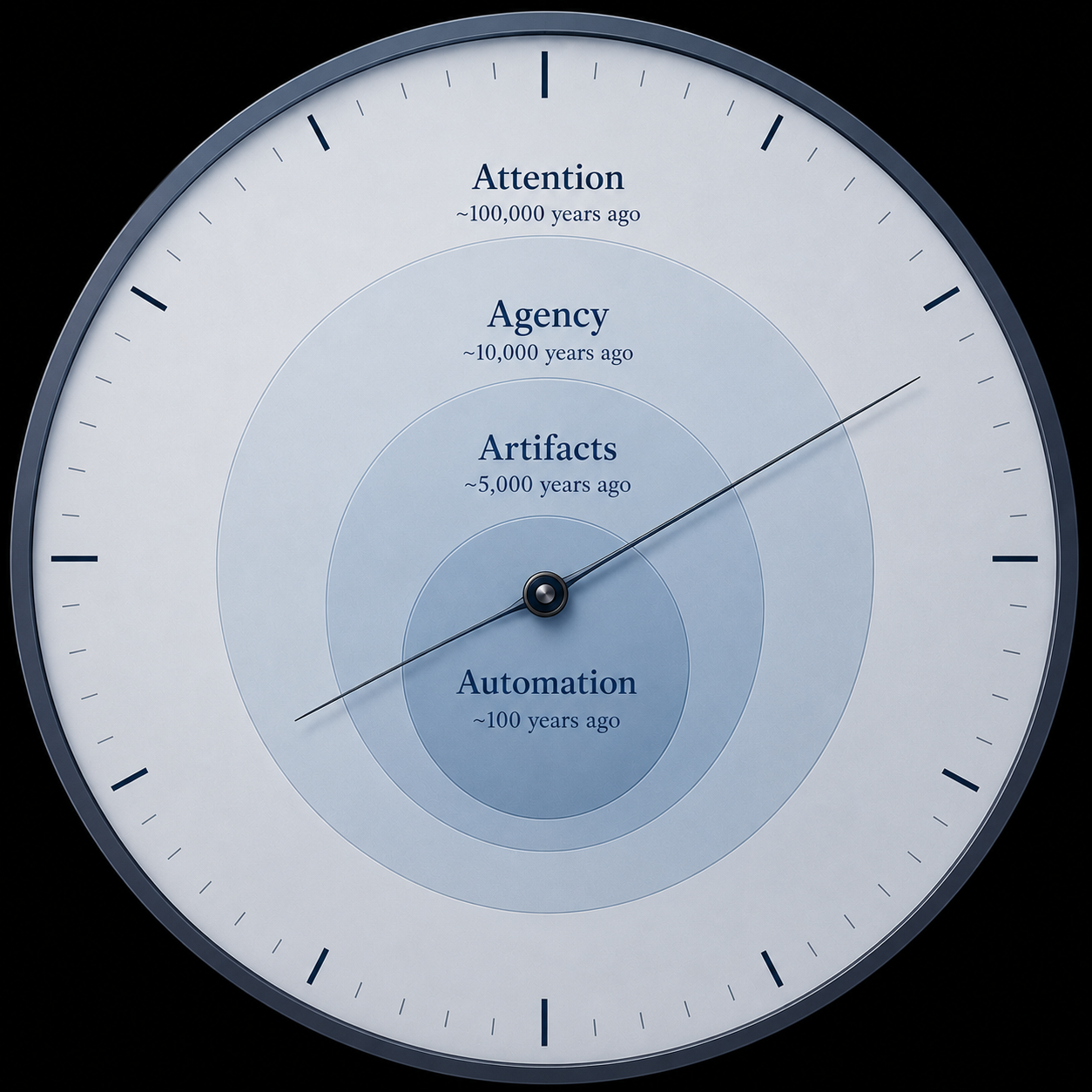
As we move through time chronologically, we can reflect on four cumulative information revolutions that have shaped our information capabilities:
- Attention: The emergence of Homo sapiens some 100,000 years ago included the capacity for abstraction, reflective attention, and the ability to imagine alternative futures. Attention helps us as a species understand and imagine a more desirable world.
- Agency: The global rise of cities within the last 10,000 years involved our ability to create shared structural agency through social institutions. Agency concerns how we relate to others and shape the world.
- Artifacts: The invention of writing some 5,000 years ago created textual artifacts to transfer knowledge across space and time. Artifacts enable us to create, share, and augment knowledge.
- Automation: The invention of automated information processing technologies within the last 100 years empowers us to automate tasks that previously required human intelligence. Automation enables us to create artificial agents that can augment human intelligence.
Together, these layered innovations provide us with a temporal and practical compass for deep engagement with information and time. Even in our most basic information activities, we can consider four questions:
- How is our attention involved? This question situates us within the trajectory of our species, from our origins to our possible destinies.
- How is our agency involved? This question invites us to participate in shaping our memories of and aspirations for human civilization.
- How are we engaging with artifacts? This question asks us to consider how our how we are interacting with, contributing to, and curating the cultural record?.
- What is the role of automation? This question calls us to participate in the trajectory of technological integration and direct it to create desirable futures.
Our current information revolution should not supersede but rather advance those that have preceded it. The capacity for attention remains a unique advantage for our species. Structural agency depends on shared intentions and goals that enable us to shape and sustain our highly technological civilization. And we continue to depend on the collection of information to remember past discoveries, imagine new futures, and create new knowledge. Keeping these layers of information in mind—attention, agency, artifacts, and automation—as we encounter information can help us navigate current changes and create a better information environment and world.
For more, see Hope in the Library: How Libraries Can Help Shape Our Future with Artificial Intelligence.