One of the themes that runs through my work, professional and scholarly, is how our encounters with information can deepen our experience of time.
The Long Now Foundation has always been a source of inspiration for me, and a few months ago I submitted a concept for their Book of Time project. My proposal was not accepted, so I’ll share it here.
Augustine described our experience of time as a simultaneous presence of the past, future, and present. Our perceptions of the present—as individuals as well as societies—are informed by our memories of the past and expectations about the future. During moments of significant change, when we are overwhelmed with unique and urgent present realities, we can be distracted from what we have learned from the past as well as our greatest hopes for the future. This is certainly true right now, as we wonder and worry about the impact of AI on people, work, societies, and the environment. One frame that can be helpful is to consider how the impacts of previous information revolutions can help us navigate our current one.
All of our encounters with information provide opportunities for richer temporal experiences. Too often, we interact with information in fleeting and fragmented ways. We search for an easy answer to a basic question or a quick resolution to a simple problem. Or we research specialized questions and solutions without considering broader relevancies or impacts. But engaging with information involves us in a deep history that can help us unify our experiences with and understanding of time—if we consider the ways we have encountered information throughout history.
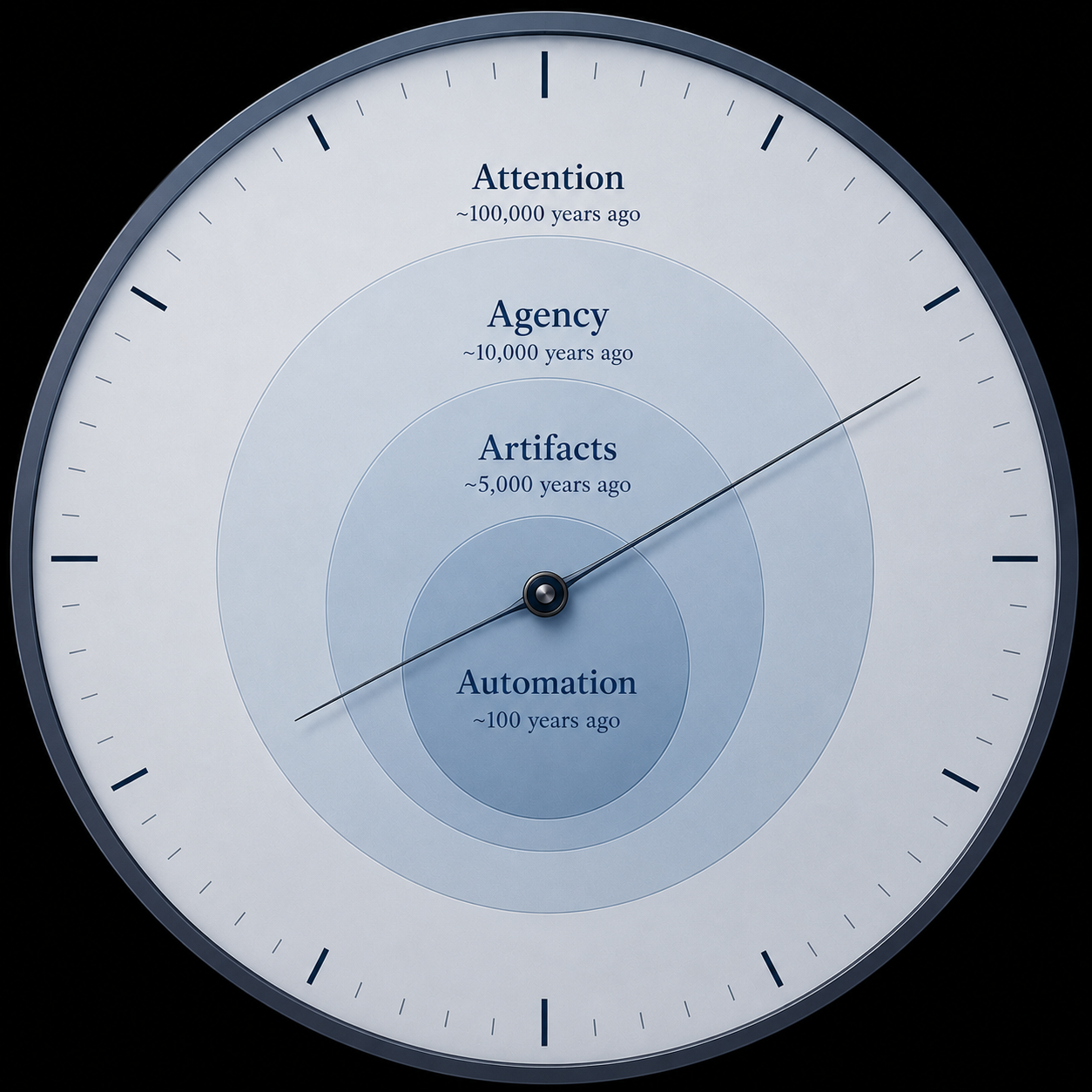
As we move through time chronologically, we can reflect on four cumulative information revolutions that have shaped our information capabilities:
Attention: The emergence of Homo sapiens some 100,000 years ago included the capacity for abstraction, reflective attention, and the ability to imagine alternative futures. Attention helps us as a species understand and imagine a more desirable world.
Agency: The global rise of cities within the last 10,000 years involved our ability to create shared structural agency through social institutions. Agency concerns how we relate to others and shape the world.
Artifacts: The invention of writing some 5,000 years ago created textual artifacts to transfer knowledge across space and time. Artifacts enable us to create, share, and augment knowledge.
Automation: The invention of automated information processing technologies within the last 100 years empowers us to automate tasks that previously required human intelligence. Automation enables us to create artificial agents that can augment human intelligence.
Together, these layered innovations provide us with a temporal and practical compass for deep engagement with information and time. Even in our most basic information activities, we can consider four questions:
How is our attention involved? This question situates us within the trajectory of our species, from our origins to our possible destinies.
How is our agency involved? This question invites us to participate in shaping our memories of and aspirations for human civilization.
How are we engaging with artifacts? This question asks us to consider how our how we are interacting with, contributing to, and curating the cultural record?.
What is the role of automation? This question calls us to participate in the trajectory of technological integration and direct it to create desirable futures.
Our current information revolution should not supersede but rather advance those that have preceded it. The capacity for attention remains a unique advantage for our species. Structural agency depends on shared intentions and goals that enable us to shape and sustain our highly technological civilization. And we continue to depend on the collection of information to remember past discoveries, imagine new futures, and create new knowledge. Keeping these layers of information in mind—attention, agency, artifacts, and automation—as we encounter information can help us navigate current changes and create a better information environment and world.
After my first read of this document, I wanted to get some of my initial thoughts down. These coalesced around five focal areas most closely connected with my work and research.
1. Building a Better City
Pope Leo uses the image of the city to present a way forward with artificial intelligence. In the biblical story of the buiding of the Tower of Babel (Gen 11), “collective effort follows a plan that dominates and ultimately dehumanizes” through control and efficiency (90). Alternatively, the biblical account of Nehemiah rebuilding the walls of Jerusalem (Neh 2) is a story about a “project of shared responsibility” for the common good (90). Pope Leo asks us to reflect on the great “construction sites” of our era and consider which projects we are working on, and in what manner. “Technology in never neutral,” the encyclical acknowledges, therefore “the primary choice is not between a ‘yes’ or ‘no’ to technology,” but rather between building Babel or rebuilding Jerusalem (9). If we chose the “way of Nehemiah,” working together “to foster a peaceful, just, and dignified life in community within today’s ‘cities,’” we come closer to the vision of New Jerusalem revealed at—and as—the end of the biblical narrative in the book of Revelation (10; Rev 21-22). The quotation marks around “cities” indicate that these cities can be thought of as metaphorical, but the encyclical refers to social structures that include real cities. It states that “we are called to cooperate in the work of creation,” and that “nothing will be lost that is authentically human … every authentically human achievement” will be redeemed (233).
In my book Artificial Intelligence and the Apocalyptic Imagination: Artificial Agency and Human Hope, I write about the meaning of the city and how it can help us think about AI. The city is one of humanity’s greatest technological achievements, and throughout history it has been an image of a technological society. In Revelation, also called the Apocalypse of John, the image of New Jerusalem is presented in opposition to the image of Babylon. The message of the Apocalypse is that the latter evil city, manifested in imperial cities such as Rome in the first century, is doomed and falling; the good city of God is arriving in the other first-century cities named in the Apocalypse and will be established fully as the fulfillment of history. Various types of technologies are included in all the cities of the Apocalypse, and the book includes ethical critiques of technologies, strategies for resisting and reforming technologies, and affirmations that technologies can be part of creating better cities and “making all things new” (Rev 21:5, which is quoted in the last paragraph of the encyclical).
The encyclical reminds us that beneath imperial narratives, from Babel through Babylon, “there is a more hidden but decisive story” of regular people performing everyday works of transformation:
“Their testimony demonstrates that goodness does not advance automatically, but requires the perseverance, memory, and interior conversion necessary to begin anew, even after defeat (125).
“While the tumult of confusion is all around us, goodness grows silently from the earth. In the words of the prophet Isaiah: ‘Behold, I am doing a new thing; now it springs forth, do you not perceive it?’ (210; Is 43:19).
“A closer analysis of history confirms this …” (211).
The cities addressed in the Apocalypse were transformed by Christians inspired by the hopeful vision of New Jerusalem. This vision can help us imagine how we can integrate AI into our lives and world wisely, as architects of hope who are “committed to building the world for the common good” (236).
“The New Jerusalem” by Gustave Doré.
2. Our Unique and Urgent Moment in Our History with Technology
As Rerum Novarum did, Magnifica Humanitas engages with the “new things” of our time. Technology has “formed part of our history since the beginning,” but AI is something new (4). The encyclical acknowledges that, “We are living through a rapid phase of transition, a ‘change of era’” (6). There is a “new dimension of our common home”—shaped by and for AI—“an environment in which we are immersed, as well as a force with which we must engage” (110). The encyclical is presented as a resource for navigating an “epochal change” and a new reality (229). This new reality requires new ethical frameworks and institutions for discernment and action, individual as well as collective.
3. An Ethical Framework for Understanding a New Reality
Magnifica Humanitas provides a grammar, definitions, and a framework for informing a human-centered moral imagination about AI. It states: “In the era of artificial intelligence, when human dignity is threatened by new forms of dehumanization, ours is the pressing duty to remain profoundly human” (15). To protect the human person, the encyclical identifies five principles for reflection: “the common good, the universal destination of goods, subsidiarity, solidarity, and social justice” (46).
The common good provides the conditions for human fulfillment, which now include “patents, algorithms, digital platforms, technological infrastructure, and data” (67).
The universal destination of goods means “finding ways of ensuring universal access to both technologies and the education needed to use them” (109).
Subsidiarity refers to the respective rights and responsibilities of individuals and institutions throughout society. This requires that technological decisions “not be imposed from above in an opaque and unilateral manner, but instead be directed toward the common good with transparency, accountability, and meaningful forms of participation” (71).
Solidarity “is the concrete recognition that the future of each individual is connected to the future of all” (73). It extends to our “digital ecosystem” and “demands that decisions regarding data, algorithms, platforms, and artificial intelligence take into account not only the immediate benefit for a few, but also the impact on all peoples and on future generations” (76).
Social justice, “which begins with the least among us,” helps us recognize “structures, mechanisms, and economic and cultural systems that produce inequality almost automatically” (78-79). In the digital age, “a just social order guarantees everyone equal access to opportunities, protects the youngest and weakest members of society, combats hate and misinformation, and subjects the use of data and technology to public oversight, so that the guiding principle is not solely profit but the dignity of every person and the common good of all people” (80).
To support shared reflection and action related to these principles, the encyclical calls for shared standards, about “the dignity of the human person, the universal destination of goods, the preferential option for the poor, care for our common home, and peace,” as well as shared practices “such as responsible planning, the assessment of human and social impact, the inclusion of the most vulnerable, the promotion of digital literacy, and guiding research and industry toward justice and peace” (14).
Magnifica Humanitas observes that “our hearts yearn for an approach [to AI] that is wise and benevolent” (230). Drawing from the Catholic Church’s social teaching, this framework provides foundational elements for considering what human flourishing looks like.
4. The Role of Educators and Educational Institutions
Magnifica Humanitas points out that the historical record provides “evidence that humanity is capable of creating institutions that protect our shared life” (123). “Just institutions,” intervening with daily acts of faith, sustain hope and provide “clear direction for technological projects without allowing the heart to regress” (126). (My most recent book, Hope in the Library: How Libraries Can Help Shape Our Future with Artificial Intelligence, argues that libraries can be such places.)
Educational institutions—“where new generations can learn to seek and love the truth, to reflect on the meaning of life, and to recognize the dignity of every person”—have a crucial role in safeguarding humanity (143). The encyclical calls on educators and educational institutions to preserve truth as a common good, cultivate reflective attention, provide “time for development and for engagement with reality beyond appearances,” and teach people “to decide when and for what purpose” AI should and should not be used (140). It identifies a number of challenges to address: improving access to education; updating curricula; supporting professional development; promoting an “integral education that addresses every dimension of a person”; preserving “the essential exercise of research, reflection, and discernment”; integrating new information into deeper knowledge; and maintaining a sense of purpose (145, 146).
The encyclical also calls on educational institutions to translate ethical principles into educational goals that are “relevant and effective in addressing the digital revolution, including: “teaching students a sense of moderation and limits; recognition of the rights of others and of future generations to enjoy the goods that are either provided for us or made available by human ingenuity; freedom and responsibility; and a sense of transcendence and the common good” (47, 147).
As the director of a new technology institute at a university, focused on (in the words of Magnifica Humanitas) “integrating the possibilities offered by technology within a framework marked by wisdom” (237), I appreciate the broad framing of what is needed for this transformative moment in higher education:
“Let us invest in education, beginning with ourselves! We all need to learn how to engage with the digital world in a human way … we need adults to rediscover their vocation as artisans of education, prepared to work patiently each day, with the support of extensive and shared educational partnerships. Today, accompanying children and young people in using technology for developing responsible relationships, helping them to recognize the risks and choose what fosters inner freedom, is a concrete form of charity and will safeguard their dignity. Teaching new generations that technological evolution does not follow a predetermined path, but can be guided by personal and collective responsibility, constitutes one of the most valuable services to the common good” (238).
We also need to be preparing people for the future of work, to become builders who can “‘choose with care how to build’” and be ready “to enter the construction sites of history—research laboratories, technology companies, schools, the media, institutions and local communities—in order to rebuild what has collapsed and protect what is threatened … so that, even when a technocratic mentality or partisan interests seem to prevail, the human city may become a more fitting place to live” (229, 1 Cor 3:10; 241).
5. The Transformation of Work
Magnifica Humanitas, like Rerum Novarum, centers the dignity of work and workers. Work is a “the essential key” to understanding our social condition. Through work we “contribute to the progress of society and the common good, put to good use the capabilities we have received, improve and beautify the world, support our families, engage in cooperative relationships and, through listening and dialogue, learn to build together something that no one could achieve alone” (148). Work is not merely instrumental: “it expresses and enhances the dignity of our lives; it is a requirement of the human condition, a normal path toward maturity, development, and personal fulfilment” (149). Nor is work “merely a source of income but a crucial sphere in which identity is formed, friendships and relationships are forged, practical responsibilities are learned, and one’s vocation is discerned” (167). Work is an important part of what it means to be—and become more—human, and it is the means through which we transform nature and create a better world.
While it is not yet clear how AI will change the world of work, AI is already changing jobs, careers, and vocations—automating some tasks, augmenting others, and creating new forms of work. And not all of these changes are good. Workers need to adapt to work with AI, but more importantly AI needs to be adapted to advance work that is meaningful. (My current book project provides a framework for creating meaningful work with AI.)
The encyclical addresses concerns about workplace disruption and unemployment, noting, “The pursuit of greater profits cannot justify choices that systematically sacrifice jobs, because the human person is an end, not a means, and the economic order must remain subordinate to human dignity and the common good” (152). “We need adaptive tools, including well-structured models, local initiatives, progressive redistribution, and new rights of access to essential goods. While not pursuing an abstract harmony, we must build concrete forms of human coexistence at this time of transformation” (153).
AI Wisdom
As its title indicates, the ultimate concern in Magnifica Humanitas in not AI—and its impacts in education, work, and other domains—but rather human dignity: “if technology becomes the ultimate criterion, the human person risks being reduced to data, a cog in a machine, or a commodity. If, however, technology is integrated with a wise perspective, it can become an instrument of growth, justice, and fraternity” (180). This is a shared responsibility, to be guided with foresight “by institutions capable of regulating without stifling, and protecting without taking over; by businesses that recognize work and dignity as measures of success; by intermediary organizations and educational communities that rebuild trust and relationships; and by citizens who cultivate responsibility, moderation, discernment, and a sense of truth” (181).
Magnifica Humanitas is call for all of us to become architects of hope, capable of cultivating AI wisdom—using AI wisely to become wiser for the benefit of the common good.
Artificial intelligence is changing how we think and work. In recent years, new forms of AI have pushed universities to the forefront of institutional change. Higher education professionals now face a dual challenge: shaping the future of their own work while preparing students to shape the future of all professions. This moment presents educators with a unique opportunity to model how all of us can reflectively and responsibly engage with AI in ways that enhance human dignity, creativity, and agency.
To create meaningful work with AI, we need to understand how information practices developed in the past, as well as establish new ethical foundations in the present for imagining desirable futures. The invention of writing led to the invention of the library, and the invention of the printing press led to the invention of the research university. We do not know yet what types of institutions will emerge following the invention of AI, but we do know these will be shaped by our deliberations and decisions today. We created AI and the social systems with which these technologies are entangled; designing our future with AI is our responsibility and work.
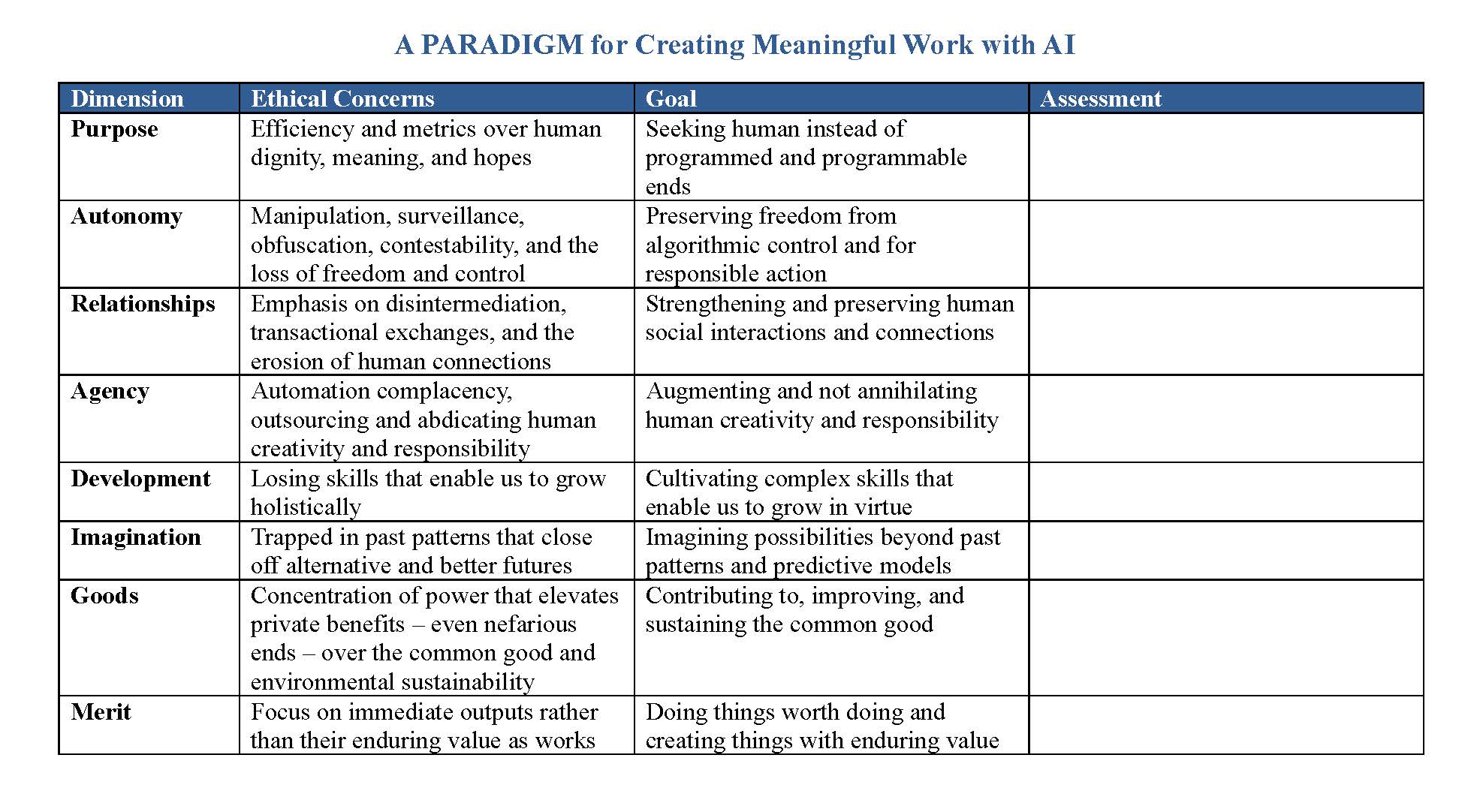
My current book project offers a historically and ethically informed framework for that work. It is called PARADIGM, which is an acronym for the elements of meaningful work: purpose, autonomy, relationships, development, imagination, goods, and merit. The PARADIGM framework can help us reflect on, imagine, and create meaningful work with AI within and beyond the academy.
Dante’s Hell is populated by those “who have lost the good of the intellect.” They have passed through the gate over which are inscribed the words, “Abandon all hope, you who enter here” (Inferno, Canto III). Dante’s vision is didactic as well as poetic. Through his art, he seeks to awaken the imaginations of the living to reflect on their anticipations, desires, and commitments. Are they too small, confused, malformed, or harmful to them and others?
Many are fearful or at least anxious about AI. I think what most people are concerned about is losing what is good about human intelligence. This is a valid and pressing concern: The history and future of AI is about automating more and more tasks—good, bad, and ugly—which previously required human intelligence.
In my new book, Hope in the Library, I describe libraries as places of hope. Over their entrances should be inscribed the words, “Attend to all hope, you who enter here.” Throughout their long history, by cultivating human attention and agency, libraries have helped us preserve, enhance, and direct the good of the intellect through significant social and technological changes. They also can help us imagine and create more meaningful work with AI.
I do not believe we can create an AI Paradiso. In the Apocalypse of John, which I discuss in connection with AI in my previous book, the image of that ideal is called New Jerusalem—the absolutely new and true city of peace. But if we pursue greater hopes, loves, and beliefs, as Dante’s Inferno encourages us to do, I believe we can create something closer to Francis Bacon’s utopian New Bensalem, the child of the city of peace.
My hope for Hope in the Library is that it will inspire hope for ourselves, our societies, our species, our world, and the institution that can continue to help improve all of these: the library.
Image: William Blake’s drawing of Dante and Virgil entering the gate of Hell (1827).
A few weeks ago, I visited an exhibition at the Louisiana Museum of Modern Art in Denmark called “The Irreplaceable Human—Conditions of Creativity in the Age of AI.” The scale and substance of the exhibition was impressive: it presented a number of installations provoking reflections on how we can continue to curate and cultivate human creativity as we increasingly integrate AI into our work and lives. The exhibition’s artists and commentators argue that creativity—the ability to create new and valuable things—is an inherent part of human nature and our narratives. Our capacity for creativity has enabled us to evolve, survive, develop, and thrive as a species.
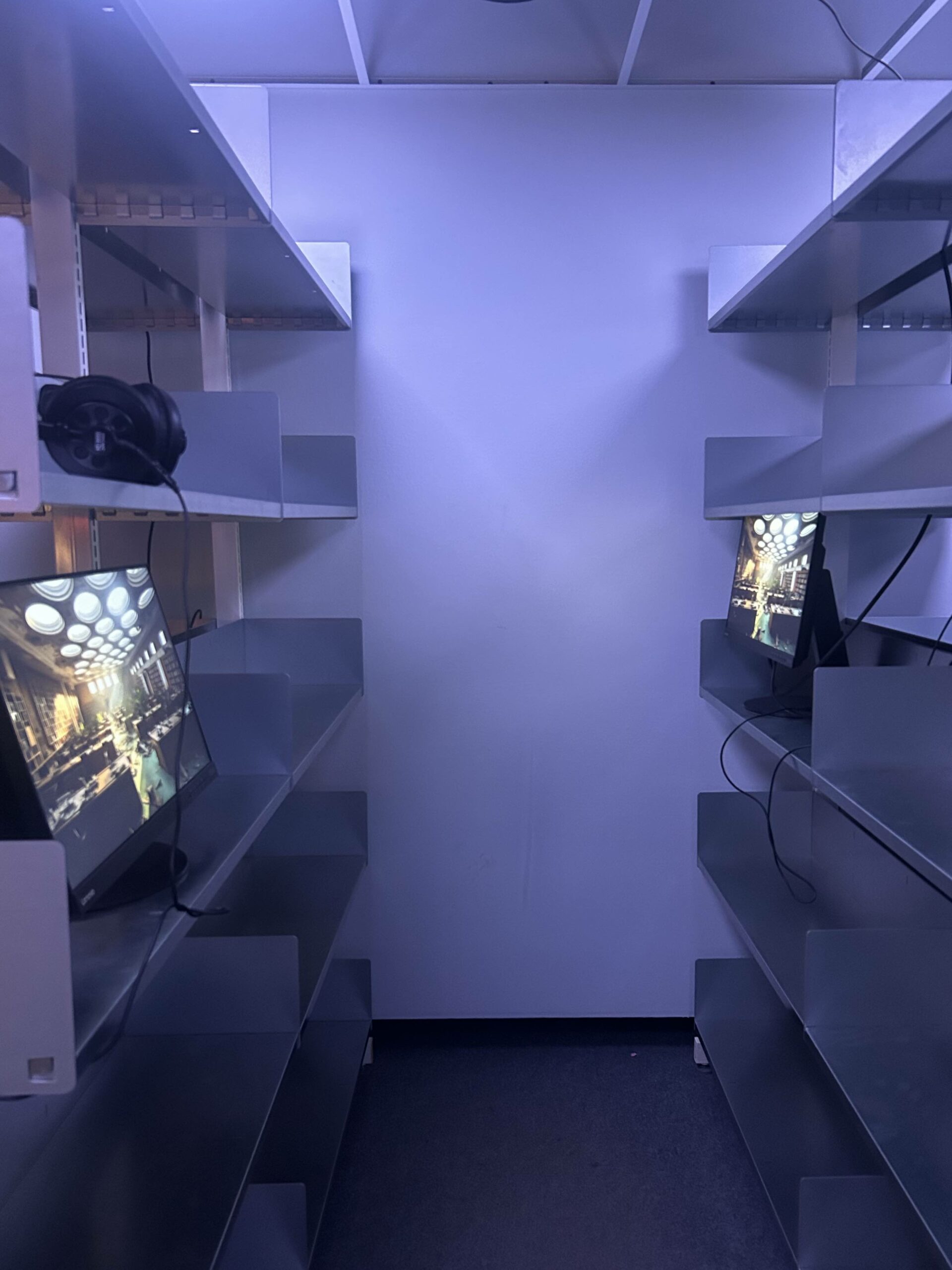
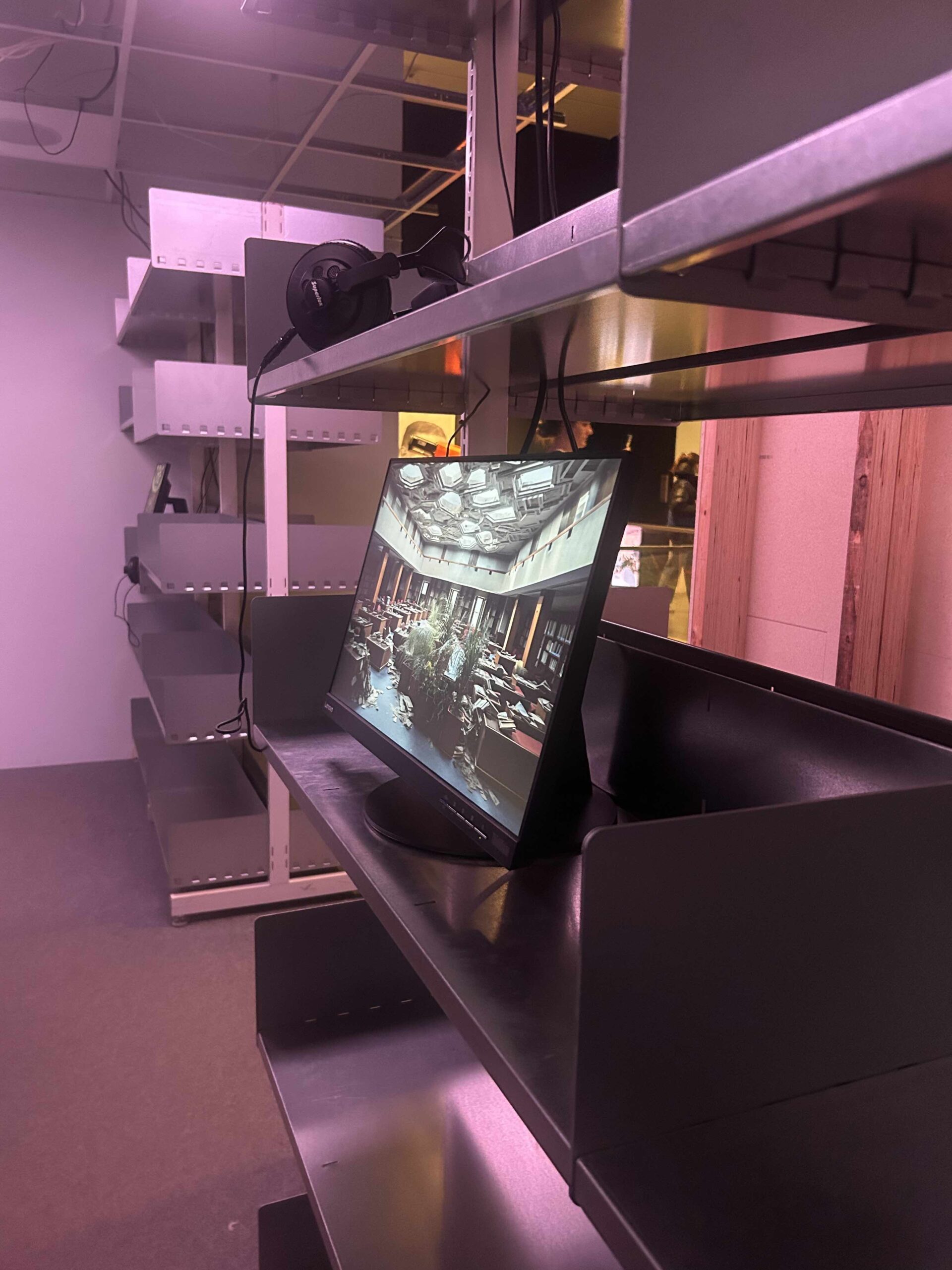
One project that was of particular interest to me was Yuri Pattison’s Open Stacks (2023). The installation included ranges of library shelves, empty but for a few computers. In this seemingly abandoned library, the computers’ monitors and headphones presented a video and narrative created with AI. The images included vacated and decaying readings rooms; the narrative was about how AI absorbed, replaced, and superseded libraries. The human institution of the library, which created a diverse and dynamic information environment, has been reduced to a recursive, homogenous, and commercialized information marketplace. The narrative asks if this is the final chapter for human creativity—or if we still have agency as authors and librarians.
A generation ago, we had to articulate and discern the relationship between the library and the internet. The best strategies we implemented focused on augmenting library resources, services, and spaces rather than annihilating them. Now we are having similar conversations about AI, which holds great promise for further transforming libraries and the ways they curate and cultivate human creativity. The history of the library is a history of sustaining the hope that there is always something new and valuable happening. Those coming new creations, and the practices of human evaluation that attend to and enable access to them, is work that should not be—and likely cannot be—fully automated.
In a recent post, I argued that libraries have an important role in creating a better information environment for human as well as artificial agents. That post touched on the long history of libraries and information technologies, as well as current concerns related to generative AI from the perspective of information ethics. In this post, I explore various ways we can expect AI to transform library processes and practices. Given the need for proactive design and intentional use of AI within and beyond libraries, I focus on the importance of information practices.
AI and the Information Lifecycle
The configuration of libraries has always been linked with the lifecycle of information: information is created, transmitted, and used to create more information. Within this cycle, libraries perform specialized functions—such as collecting, organizing, preserving, and mediating access to information—so that information may be used and generate new information.
Libraries have taken on different functions within the information lifecycle throughout history. Some years ago, I argued that complexities associated with digital materials caused libraries to reposition themselves within this cycle: they have shifted closer to the point of the creation of information to ensure immediate and long-term access to it. With recent advances in AI—especially generative AI—library functions within the cycle are changing dramatically as well. Automating more information processes that were previously performed by humans will require proactive and ethical design, as well as ongoing oversight. To enable us to use AI intentionally and wisely, we need to develop new information practices for both information professionals and users of information.
AI and Information Practices
Information practices consist of skills that enable participation in our increasingly complex information environment effectively and ethically. In After Virtue (Notre Dame, 2007), Alasdair MacIntyre argues that practices depend on and can cultivate virtues. A practice, according to MacIntyre, is:
a coherent and complex combination of skills;
a socially established and cooperative activity;
dedicated to securing moral goods internal to it;
embedded in a moral narrative or framework about the goods and ends involved;
participation in a shared moral tradition with standards of excellence upheld by other expert practitioners and supporting institutions.
Using the virtues Shannon Vallor identifies in Technology and the Virtues: A Philosophical Guide to a Future Worth Wanting (Oxford, 2016)—which she argues are the virtues most crucial for flourishing in our current technosocial condition—the relationship between information skills, ethics, and virtues can be aligned in a way such as this:
Information Practices
Information Virtues
Information Skills
Information Ethics
Reflect on intentions, the nature of information, and information needs
Discover, interpret, critique, manage, and synthesize information
Authenticity; Access; Privacy; Security
Honesty; Humility; Empathy; Flexibility
Use information ethically and effectively
Agency; Intellectual Property; Community and Citizenship
Justice; Care; Civility; Magnanimity
Artificial and Human Agency
As we allocate more of our work and agency to AI, we need to be attentive not only to how automated processes are designed and managed but also to the creation and cultivation of related information practice—which are also formative practices.
Here is a high-level framework showing how new automated processes could be balanced with human (in)formation practices that are ethical and virtuous:
Information Function
Automated Processes
(In)Formation Practices
Selection
– Creation of new materials to collect – Selection of materials for use
– Disciplined, courageous, and wise reflection on information needed for selection and use (e.g., research) – Discerning selection of diverse and inclusive resources
Mediation
– Classification and description of materials – Analysis of collection materials – Discovery and research assistance (e.g., conversational AIs) – Use analysis of resources, services, and spaces
– Equitable, safe, and secure access to resources, services, and spaces – Honest, humble, and charitable critiques of information sources and networks – Just, caring, and civil synthesizing and sharing of information
All of this requires much more development and specificity, but I think it points to the need for us to focus more on information practices as we continue to automate more information processes.
IEEE Spectrum recently published an AI “apocalypse” scorecard related to current hype associated with large language models. “The AI Apocalypse: A Scorecard: How Worried Are Top AI Experts about the Threat Posed by Large Langualage Models Like GPT-4?” summarizes the perspectives of 22 AI “luminaries” on two questions: (1) whether today’s LLMs are a sign that artificial general intelligence (i.e., human-like intelligence) is likely; and (2) whether such an intelligence would “cause civilizational disaster.”
Here is a tally of the results:
AGI? 14 scored no, 8 yes
Civilizational disaster? 12 scored no, 4 yes, 6 maybe
I just published a book that attempts to broaden how we think and speak about the apocalyptic imagination. Due to the popularity of certain apocalyptic works, “apocalypse” often refers to the end of reality as we know it. More broadly (and historically) understood, an apocalypse can uncover our hopes as well as our fears. (I explain this and provide an overview of the book in its introduction, which is subtitled “Imagined and Real AI.”)
After exploring a number of concepts such as attention, agency, augmentation, and ethics in the book, I introduce a rather different type of apocalyptic scorecard in the fifth chapter. In this scorecard, I ask a set of questions that may help us assess real as well as imagined AI:
Reflective attention: What ultimate hopes and goals are identified? Are these sufficiently critical, multicultural, and participatory? Does the AI ecosystem provide the conditions for cultivating constant critical reflection on and refinement of these, individually and collectively?
Structural agency: What advantages of collective action are used to realize shared goals? Are the AI structures and systems designed to support these ends continuously curated to ensure they enhance rather than inhibit human agency?
Knowledge augmentation: Are people growing in knowledge and seeking greater wisdom? Do AI systems support this growth?
Ethical foundation: Do the AI systems advance political, economic, and social justice and peace?
Reformation: What formative practices accompany AI systems to shape individual and collective attention and agency with, against, and beyond these systems? When AI systems do fail, how may they be rejected, reformed, or resisted?
The last chapter uses this scorecard to evaluate realistic and imagined AI futures depicted in AI 2041: Ten Visions for Our Future, by Kai-Fu Lee and Chen Qiufan, and in Max Tegmark’s Life 3.0: Being Human in the Age of Artificial Intelligence.
I was agnostic about AGI when I wrote this book a year ago, but we do seem to be coming closer to something similar to it. I am not concerned about existential risk (i.e., the elimination of our species or civilization). I agree with many others who say there are plenty of real risks that need to be addressed now if we want to improve the quality of our lives and world. A robust apocalyptic imagination—and scorecard—can help us realize better futures.
One of the great challenges—and opportunities—of our age is the pursuit of digital wisdom. To thrive in our digitally enabled and enhanced information environment, we need to learn how to design and use digital information and communication technologies (ICTs) wisely so that we may become wiser. Right now, this includes discerning how AI may be integrated wisely into our lives and world. Libraries have an important role in creating a better information environment for human as well as artificial agents.
The Role of Libraries
Our emergence as a species is connected with our capacity for reflective attention. The ability to discern information in our environment and to think about it reflectively and imaginatively—instead of reflexively and automatically—set us on a trajectory that resulted in the creation of complex information societies. As we became dependent on the ancient ICTs of writing and textual artifacts, libraries were developed in diverse contexts to enable the discovery, use, creation, and sharing of knowledge.
To manage attention and information, libraries begin with an intention to configure an intellectual ordering of reality represented by textual expressions of knowledge. This goal, defined by particular communities, involves the selection and collection of texts judged worthy of attention. It also involves the mediation of access to this collection—as well as the broader context for discovery a library curates—through social and technological systems that enable human agency within an information environment.
Library intentions, selections, and mediations have changed and grown in complexity as ICTs have changed. The digital transformation of libraries—the integration of digital ICTs into library resources, services, and spaces—has been underway for decades. Libraries automated many technical operations in the 1960s, including cataloging, acquisitions, resource management, and circulation. In the 1970s, through collaborative consortia and networked computers, libraries developed automated processes for information exchange. Libraries created new automated discovery and retrieval services through online public catalogs and remote databases in the 1980s. By the end of twentieth century, libraries were providing online access to local as well as global resources. As they were digitizing information resources and services, librarians also developed the concept and practice of information literacy—which enables people to identify information needs and find, evaluate, and use information to fulfill those needs. Over the last twenty years, digital resources, services, and spaces have become thoroughly integrated into most libraries.
Today, libraries are being rapidly and radically transformed by new automated and artificial intelligence technologies—technologies that will profoundly change how people discover, use, create, and share information. A generative pre-trained transformer (GPT), which predicts plausible responses to requests based on past language patterns, is a significant AI technology that is already changing how people engage with and think about information. Many libraries are exploring how this technology may be used to advance knowledge discovery and creation. If wisely integrated into libraries, this technology could significantly augment human attention and agency. The digital wisdom needed to realize that goal begins with reflection on a number of ethical questions.
Information Ethics and GPTs
For several decades, the field of information ethics has explored various ethical issues to assess the impacts—as well as guide the implementation—of new and emerging ICTs. An instance of a GPT, such as ChatGPT, touches many (if not all) of the concerns of information ethics.
Consider, for example, the following issues and questions.
Authenticity: Does ChatGPT provide meaningful information or rather false information (misinformation)? ChatGPTs information sources are obscure, but it is clear not all of them are good. Additionally, the current version of ChatGPT does not always provide accurate information and is well known for its tendency to fabricate or “hallucinate” misinformation. OpenAI warns that, “While we have safeguards in place, the system may occasionally generate incorrect or misleading information and produce offensive or biased content. It is not intended to give advice.”
Access: Is access to ChatGPT equitable? This question concerns not only access to the technology itself, but also to the technologies and skills needed to use it well. At this point, the business model for ChatGPT’s creator OpenAI is not clear or stable. Many GPTs are commercial products and require user contributions of personal data as well as subscriptions for advanced models. Best practices for using ChatGPT are, at best, provisional.
Diversity: Is ChatGPT inclusive of diverse perspectives? Given the lack of transparency around the texts used to train ChatGPT, as well as about human interventions meant to mitigate bias and bad information (or malinformation), it is unclear how diverse and inclusive ChatGPT is. There are questions about censorship, too, as different groups call for the exclusion of certain perspectives from their information environments.
Property: There are many open questions about ChatGPT and copyright and intellectual property rights—about ownership rights of the content on which ChatGPT is trained, on who owns its outputs and the content created in connection with its use, and about how cases for fair or transformative use will be defended when content is automatically and cryptically generated.
Privacy: How does ChatGPT access, protect, and use personal information? OpenAI warns that, “Conversations may be reviewed by our AI trainers to improve our systems” and, further, advises against sharing “any sensitive information in your conversations.” If you ask Chat GPT about privacy, you will get responses that promise anonymity and encryption but caution that “no system or service can guarantee complete security and privacy.”
Security: Does ChatGPT protect people from—or expose people to—online harm? There has been at least one case in which users’ questions were publicly exposed. If you ask ChatGPT how secure it is, it asserts that user data is restricted to “authorized personnel” and that OpenAI has implemented controls to prevent unauthorized access to or misuse of user data.
Community: Does ChatGPT foster harmonious relations among people, help cultivate citizenship, and serve the common good? When I asked ChatGPT how it serves the common good, it claimed a number of positive applications: creating mental health chatbots; developing interactive learning tools to help students learn and retain information more effectively; generating virtual assistants to help people with disabilities access information and services more easily; and analyzing and synthesizing large amounts of data to help researchers in fields such as medicine and environmental science make new discoveries and insights. ChatGPT acknowledges it also can cause social harms: it can be used to lie and slander, amplify biases and inequities, cheat and steal, disrupt relationships and jobs, and much more.
GPTs have the potential to enhance teaching, research, writing, coding and all the other work we do to process and act on information. But the intentions, selections, and mediations of GPTs need to be critiqued, governed, and reformed further to ensure that human attention and agency may be helped rather than harmed.
From Information to Wisdom
Libraries have always used ICTs to help people attend to and work with information. Through their intentional approaches to information, their selection of information resources, and their mediations of information access and use, libraries have cultivated human attention and agency to augmented human intelligence for millennia. Now, this work includes automated information processing and artificial agents. Increasingly complex forms of AI will continue to transform libraries and our information environment. Drawing on their histories and experiences of technological adaptation and ethical practice, libraries are well positioned to lead digitally wise social and technological transformations with AI.
For an introduction to information ethics, see Foundations of Information Ethics, edited by John T. F. Burgess and Emily J. M. Knox (ALA Neal-Schuman, 2019).
The COVID-19 pandemic was an apocalyptic event. It was apocalyptic in the popular sense of the word, in that the pandemic was a sudden and global catastrophe. But the pandemic was also apocalyptic in a more literal sense, as an uncovering of deeper realities. The pandemic quickly became an infodemic; it exposed and exacerbated systemic racial, economic, and other social inequities; and it revealed many of the problems and much of the potential of emerging technologies. Before the pandemic, it was clear to many that it was past time, in the words of Ruha Benjamin, “to reimagine what is possible” (Race after Technology: Abolitionist Tools for the New Jim Code [Polity, 2019], 1). Now, as we emerge from the pandemic, there is a unique opportunity to learn from this apocalyptic moment and strive “for another and a juster world” (W. E. B. Du Bois, The Souls of Black Folk [Penguin, 2018], 63).
Libraries have been central in the discovery, creation, and sharing of knowledge for millennia. Initially, the aims of libraries were modest and imperialistic. More recently, guided by professionals responsive to social and cultural dynamics, libraries have become significant sites for cultivating individual and collective agency. (See, e.g., Wayne Wiegand’s Part of Our Lives: A People’s History of the American Public Library [Oxford University Press, 2015]). Uniquely situated within both local communities and global networks, librarians and libraries are well positioned to help shape a better post-pandemic world—a world that also will be postdigital.
Librarians have participated in a trajectory of digital transformation since the middle of the 20th century: automating operations and access, digitizing resources and digitalizing services, and developing new platforms and accompanying formative practices. All of these changes enabled libraries to sustain many core programs during the pandemic, but the nearly all-digital work of librarians revealed dimensions of the library that cannot be automated or adequately mediated digitally. These pre- and extra-digital elements of the library—human-scaled interfaces, fully embodied interactions, collaborations unconstrained by software designs, data and algorithmic autonomy, temporal and physical constraints, and environmental responsibilities—provide insights into future priorities for the library. Technological advances accelerated by the pandemic, such as artificial intelligence, will continue to transform our world. (See, esp., Luciano Floridi’s The Fourth Revolution: How the Infosphere is Reshaping Human Reality [Oxford University Press, 2014]).
But libraries have always been about augmenting intelligence—indeed, libraries themselves are technologies for intelligence augmentation—and librarians can draw from a deep history of information access, attention, and agency to critique and integrate wisely into our lives transformative technologies such as AI. Ours is a time for postdigital librarianship: a critical and constructive approach to digital enhancements that lead to better futures after the digital has lost its salience. (For a discussion of “postdigital,” see Jeremy Knox, “What Does the ‘Postdigital’ Mean for Education?,” Postdigital Science and Education1 [2019]: 357-70.)
The COVID-19 pandemic, the related infodemic, the digital transformation these have accelerated, and the social and especially racial inequities these have highlighted have caused me to rethink, reorder, and refine my 9.5 theses about technology. (I share some thoughts about the most significant changes here.)
Here is the current version of these, including many updated links to relevant posts:
1. We are living through a unique and transformative moment in history. New digital and networked information and communication technologies, increasingly powered by autonomous and intelligent systems, are profoundly and irrevocably changing our lives and world.
2. Our present revelatory or apocalyptic moment uncovers old patterns of injustice and alerts us to how technologies create asymmetries of power that exacerbate old and create new social inequities. With digital technologies, we see these in divides relate to access, literacy, and wisdom.
3. Technology has been with us—and defining what it means to be a human—from the beginning. Technology had a significant role in human evolution, enabling us to become human and more human.
4. Technologies are neither inevitable nor neutral. We design and use them, creating and engaging with affordances that both enable and limit our agency. In a period of technological disenchantment, we are awakening to the responsibilities of designers and users.
6. We are digitally naïve. Individually and collectively, we need to reflect on how we are shaping new information and communication technologies and how they are shaping us, and we need to close the current ethical gap between our intentions and actions. We need to become digitally literate as well as digitally wise agents.
9. Our lives are characterized by a digital device paradigm. We interact with surface layers of technology supported by invisible substructures and surrounding environments of surveillance.
9.5. We should be humbled by our finitude and history of corruption. Innovation should be balanced with curation, acknowledging that appropriate limits are ambiguous.
Here is a presentation on these I prepared for one my classes: